What are the Five Pillars of Islam?
Published on
11/20/2024
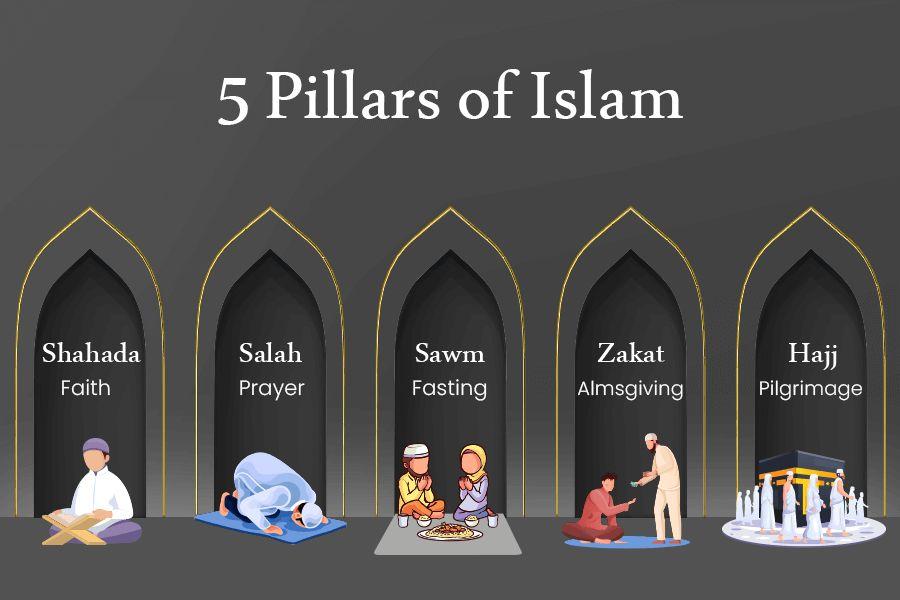
Understanding the Foundation of Islamic Faith
The pillars of Islam are a collection of core ideas that form the basis of Islam, one of the main global religions. As the cornerstones of Islamic doctrine and practice, these five pillars of Islam help Muslims in their spiritual development. Muslims try to live a life of faith, devotion, and righteousness by upholding these pillars.
The Five Pillars of Islam
- Shahada (Declaration of Faith)
- Meaning: The short yet powerful statement of faith known as the Shahada says, “There is no god but Allah, and Muhammad is the Messenger of Allah.”
- Significance: This statement, which recognises Muhammad’s prophetic status and declares the unity of God (Allah), is the cornerstone of Islam. An individual accepts Islam and becomes a Muslim by saying the Shahada with sincerity.
- Salah (Prayer)
- Meaning: The term “salah” describes the five daily routine prayers of Fajr (dawn), Dhuhr (lunch), Asr (afternoon), Maghrib (sunset), and Isha (night).
- Significance: Prayer is a direct line of communication between a person and God. It includes supplications, certain Quranic passages and physical postures. Muslims are supposed to face the Kaaba in Mecca and pray in a condition of purity known as wudu.
- Zakat (Almsgiving)
- Meaning: The required charitable donation of a part of one’s wealth to those in need is known as zakat.
- Significance: The significance of sharing one’s benefits with others is highlighted by this pillar. Zakat is given to certain recipient groups, including the needy, poor people, orphans, and tourists, and is computed as a share of one’s assets and savings.
- Sawm (Fasting during Ramadan)
- Meaning: During the holy month of Ramadan, sawm is the practice of fasting from sunrise to sunset.
- Significance: Muslims use fasting as a spiritual practice to cultivate patience, empathy, and self-control. It entails not eating, drinking, or having intercourse from sunrise to sunset. It also involves avoiding unfavourable ideas, statements, and behaviours.
- Hajj (Pilgrimage to Mecca)
- Meaning: Every Muslim who is physically capable must do the Hajj, or pilgrimage, to Mecca, Saudi Arabia, at least once in their lives.
- Significance: Muslims from all across the world come together for the Hajj, a spiritual pilgrimage. Standing on Mount Arafat, drinking from the Zamzam fountain, and walking around the Kaaba are all part of the pilgrims’ rituals. The Hajj represents Muslims’ solidarity as a world community and their obedience to God.
The Importance of the Five Pillars
A Muslim’s life is comprehensively framed by the five pillars of Islam. They provide Muslims with direction in their day-to-day activities, social relationships, and relationship with God. Muslims aim to achieve moral perfection, spiritual purity, and everlasting safety by carrying out these duties.
The Islamic pillars are a source of social justice, spiritual energy, and personal development rather than just a collection of laws and regulations. They encourage Muslims to have kind, giving, and God-centred lives.
Conclusion
The foundation of Islamic belief and practice are the 5 pillars of Islam: Shahada, Salah, Zakat, Sawm, and Hajj. They help millions of Muslims worldwide on their spiritual paths and influence their lives. Muslims want to live a life that pleases God and benefits humanity by knowing and sticking to these fundamentals.
LATEST POST